The nostalgia of cemeteries

There are a number of self-guided interpretive walks around the cemetery.

There are a number of self-guided interpretive walks around the cemetery.

I’m making a big assumption here, but I suspect that most people do not visit a cemetery as a general, pleasurable activity.  When we do wander through the grounds it is often at times of sadness, there are the memories of bitter-sweet nostalgia, or to pay our respects to someone who is dead.  I recently visited the West Terrace Cemetery where more than 150,000 bodies are buried.  This was a walking tour and talk run by volunteers with the Adelaide Cemeteries Authority.

Besides the family vaults, grand obelisks and deteriorating head-stones there is a rich history to be discovered.  What is the history behind an urn on a grave, the myths of pointy tops to the monuments, the various renditions of a a marble scroll, or the Celtic cross?  At the West Terrace Cemetery four WW 1 AIF soldiers awarded the Victoria Crass are buried there.  As you wander the rows, names from our colonial past bruise our school-time memories of history lessons, F.H. Faulding, Carl Linger, composer of The Song of Australia, or the Menz family plot are just a few.  The AIF section is Australia’s first dedicated military cemetery.  Percy Aldridge Grainger (1882-1909) was an internationally renowned musician and composer.  He apparently rated himself the fifth best composer in the world.  He was also a tad eccentric as well.  He would make his own clothing – suits, and waist coats – from terry toweling, and in his will he stipulated that the flesh be stripped from his body and his skeleton be exhibited at the Grainger Museum in Melbourne.  The executors respectfully declined to carry out this wish.

City of Singapore – ship fire, heroes, destruction and death
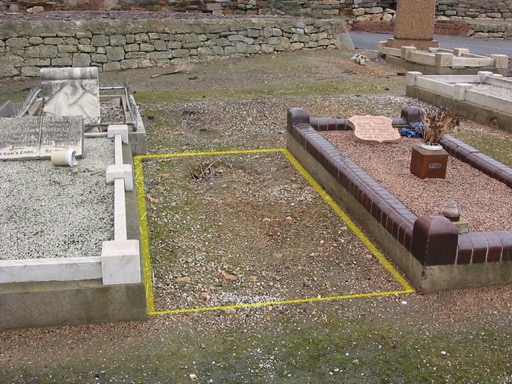
The burial site of firefighter Albert Greenman at the West Terrace Cemetery.

The burial site of firefighter Albert Greenman at the West Terrace Cemetery. The burial site of firefighter Albert Greenman at the West Terrace Cemetery. Photo courtesy of Trevor Pert, volunteer, Adelaide Cemeteries Authority (2015).

Having been a firefighter for thirteen years, I have a strong interest in commemorating and remembering those who died in the line of duty.  There is a grave in the WTC where one of three firefighters who died fighting the City of Singapore ship fire at Port Adelaide, rests.  He was Albert Greenman.

According to Fire Brigade history, from the publication Muscle and Pluck Forever, by Page and Bryant, 1983,  the City of Singapore ship-fire was on the 26th April 1924.  Quoting from page 320 of the publication:

Another body had been taken to the Casualty Hospital: that of Albert Greenman.  But when Dr Percival Cherry examined Greenman he saw there was nothing to be done.  … [He wrote at the police station] ‘This is to certify that I made an inspection of the body of Albert Greenman on a stretcher at the Port Adelaide Hospital last night at approximately 11.20 pm.  The body was dead on admission.  The skull was extensively fractured, the right half of the vault being almost entirely absent.  The brain was also absent.  The death in my opinion was instantaneous.’

According to the State Library website at Fire Brigades Headquarters in Adelaide a bronze plaque was placed commemorating the bravery of the firemen who died: GJA Anderson, James Hickey and Albert Greenman. This plaque was subsequently relocated to the foyer of the new headquarters building of the South Australian Metropolitan Fire Service in Wakefield Street.

Two of those who died in this horrendous fire, George Anderson and Jim Hickey, are commemorated by a beautiful white marble statue of a firefighter at the Cheltenham cemetery.   Local fire fighters from Woodville, Rosewater and Port Adelaide fire stations in the late 1970s restored this site and is still kept neat and tidy.

Albert Greenman’s grave has no headstone or plaque.  It is only ‘known’ through the records at the cemetery.  Why this is so I have no idea, I can only speculate.  However, it is something I want to correct.  More will come in my blogs on this intriguing and interesting page from our State’s history.

Queen Adelaide – The story of Adelaide

The Dowager Queen Adelaide, shortly before her death in December 1849.  (from The story of Adelaide p.25)

The Dowager Queen Adelaide, shortly before her death in December 1849. (from The story of Adelaide p.25)

Did you know:

Queen Adelaide was born on August 13, 1792 in Meiningen, in Germany.  She married Prince William Henry, Duke of Clarence, the third son of King George III when he was 53 and she was 25.  It was an arranged marriage, which took place in Kew Palace, London in 1818.  Prince William had ten illegitimate children before his marriage.  Princess Adelaide (as she became known), opened up her home and her heart to these children and cared for them as if they were her own.  Adelaide was instrumental in having the British Parliament enact laws to ensure that all children should be taught to read and write.  After the death of King William, Adelaide continued her charity work, donating money, mainly to assist disadvantaged children.  Adelaide died on December 2, 1849, aged 57 years and was deeply mourned by the English people.

The Queen Adelaide Society Inc. was formed in Adelaide by the late Dorothy Howie in 1981, mainly to promote our heritage ad knowledge of Queen Adelaide, te consort of King William IV of England.

When King William’s permission was sought to name the capital of the new colony of South Australia after him, he suggested rather that it be named Adelaide, after his Queen.

Throughout her life Queen Adelaide loved children and worked for better living conditions for the poor ad better education for all children.

The Queen Adelaide Society members work on a voluntary basis in her honour, supporting needy children’s charities in South Australia.  The committee organises fundraising activities and welcome the public’s support.  A donation from these activities goes to a chosen children’s charity each year.

This information was adapted from the publication; The Story of Adelaide and the Queen Adelaide Society Inc. informations sheet.  Further information about the activities of the Society and Queen Adelaide can be obtained from the Society’s web site.

History is all around us – we just have to open our eyes

Queen Adelaide (from the publication: The story of Adelaide)

Queen Adelaide
(from the publication: The story of Adelaide)

It is four weeks since I last posted anything on my blog.  It is not because I haven’t done anything interesting, but I like to keep my posts different to the mundane activities of daily life.  My PhD writing is in the final stages – I know I keep saying that – with my new supervisor reading the thesis for the first time.  While there are suggestions and recommendations to ‘tighten up’ some of the language and add a few more references in a few places, overall he seems satisfied.  I’m treating his review as the independent examination before it goes out to the two official independent examiners – one in Australia and one overseas.

I have a couple of other projects running concurrently as well – in addition to teaching one undergraduate class (of 30 students) and stepping in for a Graduate Diploma subject whilst a colleague is overseas.  A few weeks ago I commenced the oral history research of my mother-in-law, Vida Liebelt.  The project is titled: Vida – a pastor’s wife.  So far there have been ten interviews and about eleven hours or recorded material.  Approximately six hours have been transcribed and I’m gradually undertaking the painstakingly detailed challenge of checking and correcting the transcripts against the voice.  I expect that there will be another two interviews, but I will conduct them once I have all the transcripts up to date and I can look for any gaps in the narrative.  More of this will evolve over the coming weeks and months.

About five weeks back I wrote a piece titled: Where are they now?  It was about discovering a 1965 order of service and dinner menue for 92 Queen’s Scout recipients – of whom I was one.  The research is slowly progressing.  I have met with two other Queen’s Scouts from that year and later this week I will be having lunch with one of the official party from the dinner.  While I am still unsure whether this will develop into a project or not, I’m certainly enjoying meeting with some of my fellow recipients.  There will be further updates on this as well.

During the week I heard a presentation from the Queen Adelaide Society Inc. and then on Friday (last) I visited the West Terrace Cemetary.  Both were interesting and offered some  opportunities for research community involvement as well.