On Saturday October 4, 2014 my sister Judith died. She was 79, but her life was lost five years ago with the onset of dementia. Earlier this week, at her funeral, I had to give the hardest speech of my life, Judith’s eulogy. I have added it to the stories in this Blog as part of our family’s oral history. You may enjoy my memories of Judith.
Category Archives: History
Looking for Yip Yau
Image
Let’s see how good the internet actually is for research.
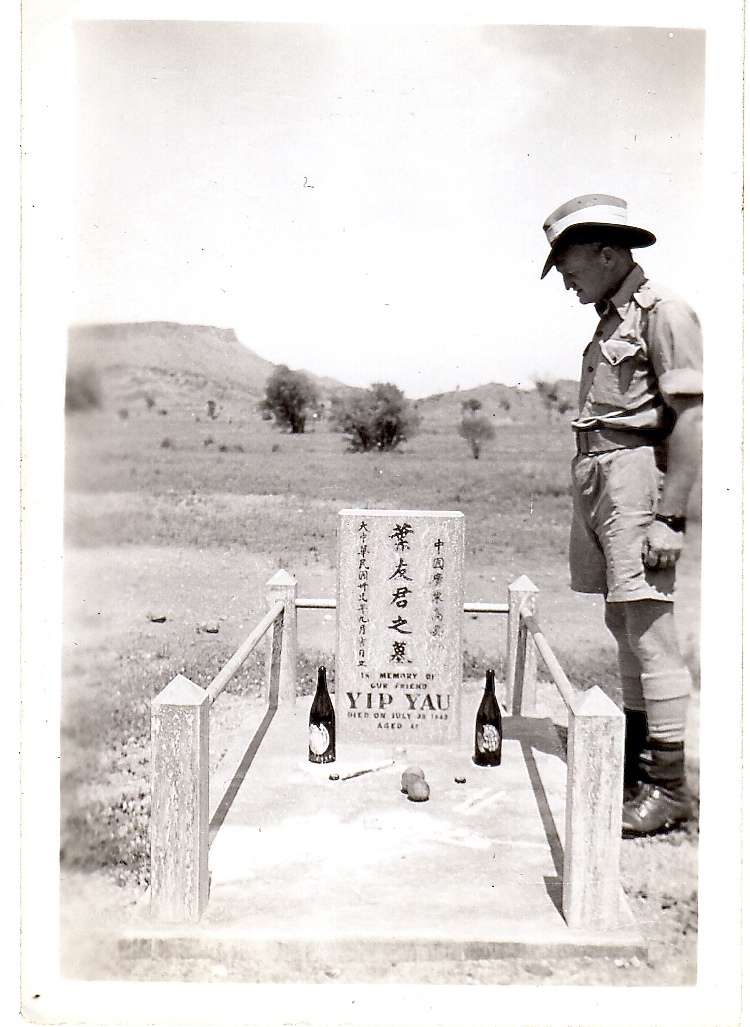
I’m trying to trace the life of Yip Yau, born in 1896, (locality unknown) died in central Australia (possible near Alice springs or further north) in July 1943 (aged 47 years).
I have a photograph of my father at his grave taken in the latter half of 1943. Yip Yau was of Chinese ancestory. The English writing on his grave stone says: “In memory of good friend, Yip Yau. died July (28th?) 1943, aged 47”.
The grave as you can see from the accompanying photograph is/was quite substantial indicating that either his family had the finances and/or that he was respected in the community.
Any glimmers of hope would be appreciated.
Oxford update
I’m starting this post with an apology. Between infrequent internet access and spending all my time exploring and experiencing the wonders of travel, my writing has not eventuated as planned. London was hectic, busy and no time to rest. However, more on this later. The train trip to Oxford was quick and without any trauma. Checked into the hotel and discovered it was 200 meters from the Wolfson College Oxford University from where I am now writing. It is a beautiful day, but the various papers are holding my interest and keeping me inside. I present tomorrow (Sunday) morning. I am prepared but have to check that it all works. One more practice. A formal dinner tonight after a day of presentations. However, I will not be drinking too much – tempted though as my favorite Scotch is available. Hopefully an update shortly and a catchup with the travels from Brighton to London and around Oxford.
Sharing the good earth
I attended a humourous and interesting discussion on the 175 year history of the Royal Agricultural & Horticultural Society of South Australia (Inc). To read more of my enjoyable two hours, follow this link.
Adelaide Photo treasures from the 1920s
What is in your ‘shoe box’? This beautiful series of photographs of Adelaide in the 1920s. I quote form the ABC web site:
Discovered in a filing box left in the old City Engineers Department of the Adelaide City Council in 2011, it is believed the photographs were taken from the bell tower of the General Post Office in the city.
Judging from the skyline and buildings, Adelaide City Council archivist Rob Thorton believes the photos were taken in either 1921 or 1922.
The first detailed series of photographs taken of the skyline since a panoramic shot taken in the 1866, the photos detail the progress of expansion and development over the five decades.
“We were amazed that these had lain dormant for all this time.
“We spent quite a lot of time almost drooling over them,” Rob laughed,” because it was such a comprehensive record of what the city looked like at that time.”
Black and White Adelaide – A collection of panoramic photographs show eight of the 12 photographs, enlarged and reproduced on canvas in the northern gallery of the first floor of the Adelaide Town Hall, 128 King William Street, from 12 May till 30 May 2014, as part of the About Time Festival. Admission is free, so check it out.
A Brief Explanation
During the past 66 years, the Baby Boomers and their families have become the most photographed body of people in history. They have grown up with the advent of mass produced cameras, cost effective film and photographic production techniques, and now, digital photomedia technology. The celebration, drama, loves, desires, and evolution of their lives have been photographically recorded, but often lies forgotten and ‘unloved’ in dusty boxes, unopened albums and cluttered drawers in homes throughout Australia. Conrad in ‘At Home in Australia’ (2003, p. 85) talks of, ‘…a treasure chest…where his parents kept their photos.’ My research opens up these containers of photographs, to investigate and record each participant’s engagement with the ‘still’ photographic mediums and its influence on them, the recording of the lives of their families, their interpretations of nostalgia and their recollections through reconstructed memory.
Australia appears to be evolving a culture, “throw it away, make room for the new, it costs too much to store, we don’t need that old stuff”. The concepts of dumping and the use of landfill sites fills me with dread. I am scared that my life, my memories, my records will be processed in to recycled packaging for a new, must have, piece of technology for the next generation. Yet this does not make me a Luddite one who is against advancement and development. I love new technology and the evolution of our culture; but in this research I argue that our history, our past, is the solid foundation on which we build our future. The old does not have to be tossed aside to make way for the new. In a poignant article in the Sydney Morning Herald about burning, selling or denying our past, journalist Bob Ellis comments: ‘…how little we do in Australia to keep hold of the past.’ (Ellis 1999)
Welcome to a Baby Boomer’s Legacy
This site was created some years ago as part of a teaching exercise. My students went on to publish great Blogs. I spent my time reading their work and did nothing myself. Over the coming weeks and months I hope to populate this site with comments on my interests, research, teaching and travel. May be the odd comment on current events might surface as well. However, it will not be a site for political ideology , or rants on other’s beliefs.